 |
|
|


|
National
Finalist 2002 Ernst & Young Entrepreneur
Of The Year Award Kauffman Supporter Of Entrepreneurship Award |
|
|
Plenary Session II
Dr.Eric Chivian, M.D. 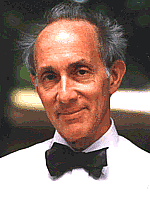
TOPIC - Understanding The Dependence Of Human Health On Nature Pleanary Session Address II: Nobel Laureate Dr. Eric Chivian, renowned for his work to protect the environment, will address the way human health is affected by nature. Global warming, environmental pollution, depletion of the ozen layer and soil erosion - are just a few of the topics that one cannot avoid seeing in the headlines these days. As more and more people around the globe are becoming aware of the direct relationship between nature and human health, it's only a matter of time before "environment" and "nature" will emerge as a new space for cutting-edge innovation. The next 25 years will see a significant increase in the number of innovations and new ventures in this area. Measuring, monitoring, pollution prevention, pollution control, and clean energy will become the hottest investment opportunities, just like security has become an important field after the 9/11 tragedy. Understanding the big picture will allow us to see the scope of opportunities that lie ahead of us. "Big picture" being the key word here. Dr. Chivian is a co-founder of International Physicians for the Prevention of Nuclear War, recipient of the 1985 Nobel Peace Prize. He also founded the Center for Health and the Global Environment at Harvard Medical School in 1996, where he currently serves as director.
Short Biography
Dr. Chivian holds an A.B. degree cum Laude in Biochemical Sciences from Harvard College, and a M.D. from Harvard Medical School. He is Founder and Director of the Center for Health and the Global Environment, and an Assistant Clinical Professor of Psychiatry, at Harvard Medical School. In 1980, he co-founded (with Professors Bernard Lown, Herbert Abrams, and James Muller) International Physicians for the Prevention of Nuclear War, recipient of the 1985 Nobel Peace Prize. During the past 14 years, he has worked to involve physicians in the United States and abroad in efforts to protect the environment, and to increase public understanding of the potential human health consequences of global environmental change. As part of these activities, he designed and organized the 1992 MIT/Harvard School of Public Health symposium “Human Health and the Environment: the Medical Consequences of Environmental Degradation”, and was senior editor and author of MIT Press’ Critical Condition: Human Health and the Environment. The book, published in 1993, the first on the subject for a general audience, has been used as a text at several medical schools, schools of public health, and universities in the United States and abroad. Editions have been published in German, Spanish, Japanese, Chinese, and Persian. In 1996, Dr. Chivian founded and became director of the Center for Health and the Global Environment at Harvard Medical School, the first center at a medical school in the United States focusing on the human health dimensions of global environmental change. The Center (designated an official “Collaborating Center” of the United Nations Environment Programme) has developed and directed the Harvard Medical School course “Human Health and Global Environmental Change” (which has been disseminated to 55 other medical schools, colleges, and universities in the U.S. and abroad); has held briefings and courses for the U.S. Congress; has been a consultant to the U.S. State Department, the Department of Defense, NOAA, NASA, and the EPA; and has advised the Environmental Ministers of the G8 nations on the health impacts of global climate change. Currently, he directs a project for the World Health Organization,
United Nations Development Programme and the United Nations Environment
Programme that is preparing the most comprehensive report yet available
“Biodiversity: Its Importance to Human Health,” which
will be presented to the United Nations Convention on Biological
Diversity, the U.S. Congress, the European Union, and other policy-maker
bodies. The report will be published as a book in 2005 by Oxford
University Press with the working title Sustaining Life: How Human
Health Depends on Biodiversity. In 1978, Dr. Chivian, with Drs. Helen Caldicott and Ira Helfand, revived Physicians for Social Responsibility (PSR), and two years later, he designed and organized the first major public symposium on “The Medical Consequences of Nuclear War,” which achieved widespread international press attention and which catalyzed PSR’s national campaign to prevent nuclear war. Dr. Chivian was the senior editor and author of Last Aid: The Medical Dimensions of Nuclear War, published in 1982 by W. H. Freeman and Co. (Scientific American), which also appeared in German, Italian, and Japanese editions. In the mid 1980’s, he directed the first scientific survey of American and Soviet teenagers’ attitudes about nuclear war and the future for the American Academy of Arts and Sciences and MIT’s Center for International Studies. Dr. Chivian was also Director of PSR’s Project on Global Environmental Change and Health from 1993 to 1996. During this time, he was senior author of a report prepared for the White House, “Environmental Health: Issues for Health Care Reform”, was a consultant to the White House Council on Environmental Quality and the White House Office of Science and Technology Policy, and a U.S. Government reviewer of the Intergovernmental Panel on Climate Change Working Group II 2nd Assessment Report. Dr. Chivian has lectured widely in the U.S. and abroad, and has appeared on national television and radio and in the print media in several countries. He has over 40 publications. His area of interest is the human health consequences of habitat degradation, species loss, and ecosystem disruption. Selected Publications
Chivian E, Bernstein A, guest editorial (2004) Embedded in Nature: Human Health and Biodiversity, Environmental Health Perspectives 112:1. Download a PDF file here. Chivian E. (editor), Biodiversity: Its Importance to Human Health, Interim Executive Summary, 2002, 2003 (2nd printing), Center for Health and the Global Environment, Boston. Download a PDF file here. Chivian E, Roberts C, Bernstein A (2003) The Threat to Cone Snails. Science 302: 5644. Download a PDF file here.
Chivian E (2001) Species Loss and Ecosystem Disruption: The Implications for Human Health. Canadian Medical Association Journal Jan: 164. Download a pdf file here.
Chivian E. Species Extinction and Biodiversity Loss: The Implications for Human Health (1993). In Critical Condition: Human Health and the Environment. MIT Press, Cambridge, MA, London, England Online Lectures Bio courtesy of Havard Medical School
|
|


| Venue | Accomodation | Contact | Cancellation Policy | Sponsorship Info | Speaker Info | Calendar | FAQ | SAEC Home | VC-Meet ™, Venture Congress ™ are trademarks of SAEC |
              
|